How does the value chain change in the era of artificial intelligence?
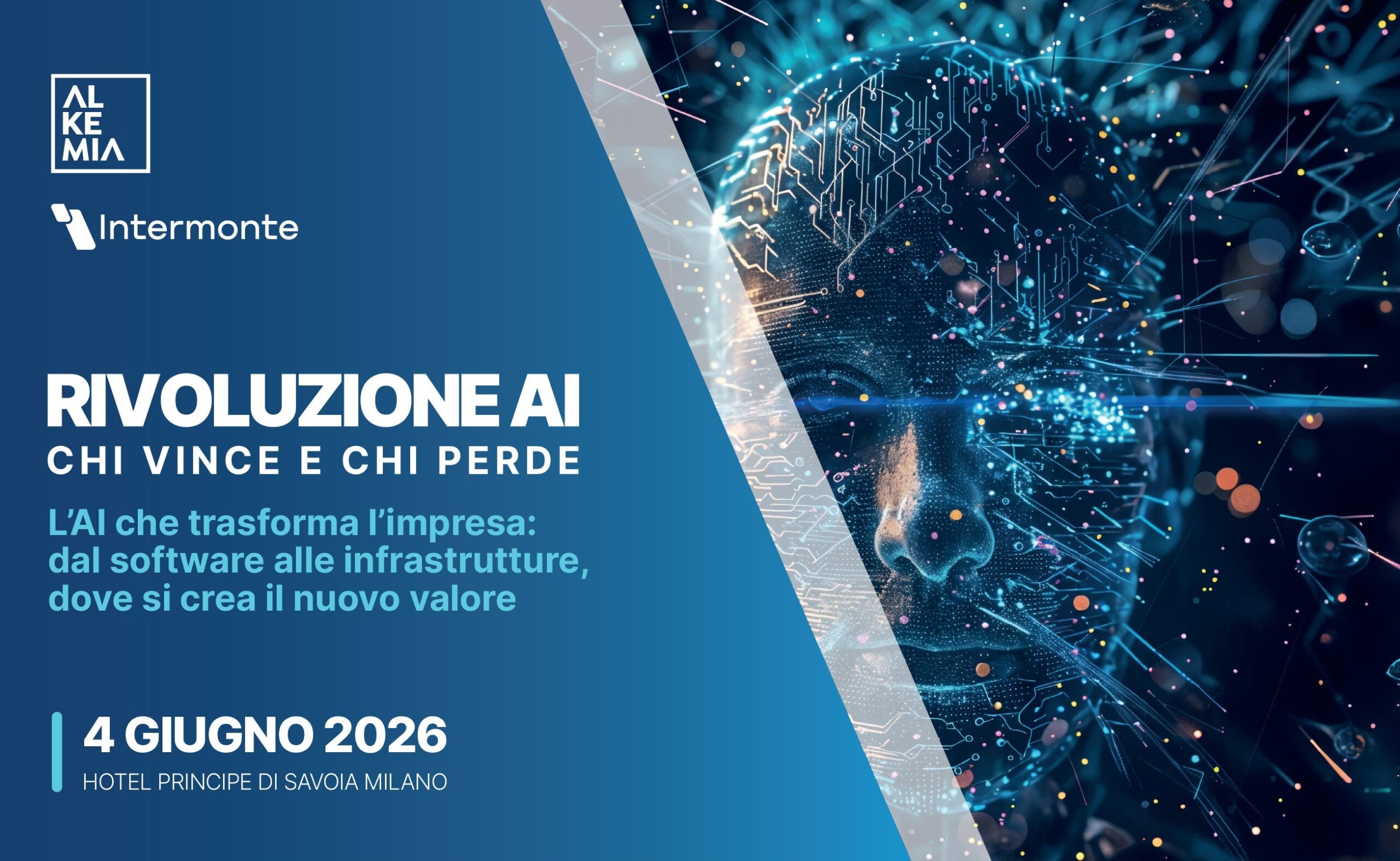
This is the question at the core of 'AI Revolution: Winners and Losers', the event held on June 4th in Milan. Organized alongside our partner Intermonte, it brought together investors, entrepreneurs, and executives from some of the leading Italian tech companies to discuss one of the most critical challenges for the future of European industry.
The discussion highlighted a clear message: the value of AI is not centered exclusively on foundational models or the mere availability of the technology, but above all on the ability to integrate it within corporate processes, data, infrastructure, and skills.
This theme ran through both of the day's panel discussions, which were moderated by Andrea Cabrini, Executive Editor of Class CNBC, and dedicated to two complementary dimensions of the ongoing transformation. The first panel brought together Roberto Tognoni (Executive Partner at Reply), Daniele Misani (CEO of TXT e-Solutions), Matteo Neuroni (CEO of SYS-DAT), Emanuele Galtieri (CEO of Cy4Gate), and Claudio Colucci (CEO of Tecno Group) to debate the role of artificial intelligence within organizations. The discussion clearly highlighted how vertical expertise, domain knowledge, and customer proximity are becoming increasingly central to turning the potential of new technologies into concrete industrial results.
The second panel, on the other hand, shifted the focus onto the enabling assets for AI widespread adoption. Davide Cilli (Executive Chairman of Comtel), Davide Sommariva (Chairman of Redelfi), Renato Brunetti (CEO of Unidata), Daniele Peli (CEO of Intred), and Antonio Baldassarra (Co-founder & CEO of DHH) delved into the role of digital infrastructure, connectivity, cloud, data centers, cybersecurity, and energy. They highlighted how the competition is not being played out on algorithms alone, but also on the availability of computational capacity, resilient networks, and infrastructure capable of supporting a demand destined to grow rapidly in the coming years.
Finally, throughout the day, keynote contributions from Carlo Purassanta (Founder & Partner at The Evident Project) and Michele Mariella (CIO of Maire) offered a strategic perspective on the main evolution drivers of artificial intelligence and their economic, industrial, and geopolitical implications. These insights helped frame Europe's role in an international competition that is increasingly defined by the interplay between technology, capital, and industrial capacity.
The speakers' insights, the debate between the companies featured in the two panels, and the pointers emerged from the dialogue with investors and market operators all pointed to a shared conviction: in the era of AI, competitive advantage belongs to organizations that successfully combine technology, vertical expertise, and execution capabilities, translating innovation into measurable results. This interpretation was further reinforced by the economic and financial analysis presented by Intermonte, which highlighted how value creation is progressively shifting toward companies capable of integrating innovation, infrastructure, capital, and distinctive skills.
Understanding where growth, competitiveness, and innovation capacity will be concentrated in the coming years represents a central challenge for businesses, investors, and institutions. Therefore, to identify the areas where value is truly being created, the dialogue between capital markets, industry, and technology becomes increasingly crucial. In this regard, the 'AI Revolution: Winners and Losers' event served as an initial platform for discussion among some of the key players in the innovation ecosystem, who are called upon to lead the next phase of development in Europe's digital and industrial economy.